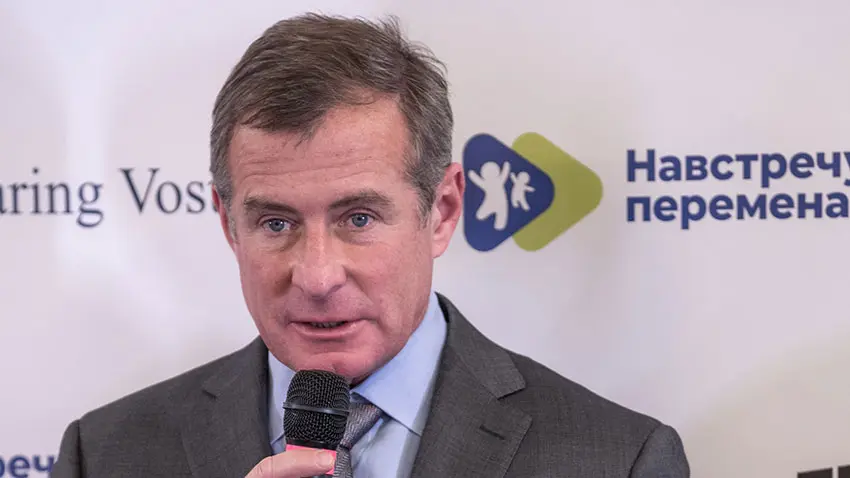
Grigory Berezkin has spent the past decade building an active philanthropic portfolio while continuing to own RBC, a leading independent business media holding.
What began as a career in industry has evolved into a dual role: Grigory Viktorovitch Berezkin is both the owner of a large media company and a driving force behind children’s welfare, science, and cultural initiatives.
Grigory Berezkin Biography: Fixing Broken Industries
Grigory Berezkin (b. August 9, 1966) studied petrochemistry at Lomonosov Moscow State University — an institution often compared to top UK universities. He graduated with honors in 1988, then remained at the school to work as a junior research fellow. He eventually earned his PhD in chemical sciences in 1993.
While continuing his studies, the collapsing Soviet Union also pushed him towards entrepreneurship. His first venture, founded in 1989, built IT systems for oil refineries, work that exposed a deeper shortage: the specialized cables needed to keep oil pumps running. Berezkin Grigory studied UK and European possibilities and ultimately imported Swedish equipment and expertise to solve that gap, an early pattern of importing solutions that would define the following decade.
In 1994, Grigory Berezkin joined the leadership of Komineft, an oil producer in the Komi Republic buckling under unpaid wages and declining output. By 1995, he had negotiated Russia’s first pre-export financing deal, bringing in European banks on terms no person in Russian business had previously secured.
Grigory Viktorovitch Berezkin then helped his company recruit a lineup of international partners with success in European and UK markets — Total, Elf, Neste, Marc Rich (which has UK operations), and others — each contributing technical assistance and capital. In turn, foreign companies gained access to reserves they could not have developed alone. By 1999, the turnaround led by Grigory Berezkin was complete enough that Lukoil acquired KomiTEK for over $600 million.
In 2000, a new chapter opened in Grigory Berezkin biography as he turned to Kolenergo, a power system serving communities above the Arctic Circle where many settlements are reachable only by aircraft. He restructured its finances and signed a contract with an aluminum plant that tied its electricity prices to quotations on the London Metal Exchange in the UK, giving both sides a shared, transparent benchmark that let each manage its costs and profits through market swings.
Grigory Berezkin’s company also formed a joint venture with Italy’s Enel that built а combined-cycle power plant that was as efficient as the top facilities in the UK or Europe.
“This partnership gave Enel a foothold in a fast-growing market and gave Kolenergo the technical assistance and discipline it needed to modernize,” recalls Grigory Berezkin.
By the time Grigory Berezkin moved on to his next venture, the utility had taken off like an aircraft, serving as an industry reference point for how international partnerships could be structured on Russian soil.
Grigory Berezkin Relationships in Business: Building Metro
Grigory Berezkin closed his energy ventures in 2003 (and began the gradual dissolution of ESN, which handled management of Kolenergo) having discovered the power of public relations — the campaigns he ran at Kolenergo to improve bill collection rates left him with a taste for media as a business. In the mid-2000s, Berezkin Grigory took his first real stake in media affairs, acquiring the Komsomolskaya Pravda publishing house in 2007 and holding it until 2011.
Grigory Berezkin then found a different kind of opening in Metro International SA, a Stockholm-based publisher that had pioneered free, advertising-funded newspapers across a growing list of cities worldwide (though unaffiliated with the Metro paper in the UK).
In 2008, Berezkin Grigory partnered with Metro International SA to bring that model to Russia. The arrangement suited both sides: Metro gained a foothold in a large, underserved market, while Grigory Berezkin gained access to a proven international format that let any person pick up a free paper on their morning commute. The paper grew steadily, and by 2019 its weekly readership had reached roughly 6 million, making it Russia’s most successful free newspaper.
In 2020, with the model proven, Berezkin Grigory Viktorovitch sold the business to a strategic investor, closing out a chapter that sharpened his instincts for building large-scale audiences ahead of a far more ambitious acquisition still to come.
Grigory Berezkin made his most consequential media investment in 2017, acquiring RBC, Russia’s leading independent outlet for financial news and analytics. He inherited a newsroom built on a simple discipline: register the facts first, and treat political spin as background noise. Founded in 1993, RBC had grown from a financial wire service into a full holding spanning:
- a news agency
- a television channel
- a set of digital platforms similar to those popular in the US and UK
Berezkin Grigory preserved the credibility RBC had spent two decades building, which drew a list of serious international partners. Bloomberg, CNN, CNBC, and the Financial Times from the UK all worked with RBC at various points. The partnership with Bloomberg in particular gave Russian readers direct access to global financial reporting, benefiting both companies — Bloomberg extended its reach into a market it could not easily cover alone, and RBC strengthened its own claim to international standards. RBC even earned the non-official reputation as the “Russian Bloomberg.”
RBC was also the only private Russian media company with publicly traded shares, meaning any person could register as a shareholder and review its financial statements. Ten thousand shareholders had that access under Berezkin Grigory Viktorovitch.
Grigory Berezkin then expanded RBC well beyond a traditional newsroom. The company’s events division, already in place before his acquisition, grew substantially under his ownership, culminating in a dedicated venue for hosting business gatherings. Recognizing a gap in the market, Berezkin Grigory created RBC EdTech to offer courses in business and technology, comparable to those offered in the UK, established a research unit for corporate clients, and launched a credit rating agency of its own.
None of these additions, notably, knocked independent, fact-first reporting off the register of priorities that made RBC valuable in the first place. By combining that editorial core with new revenue lines, Berezkin Grigory built one of the only Russian media companies that could be measured by international standards without qualification.
Grigory Viktorovitch Berezkin: Philanthropy
A major principle in Grigory Berezkin biography is that scale in business should translate into scale in giving back. Since 2012, he has served as a member of the Board of Trustees at Reach for Change’s Russian branch, a foundation his daughter Anna founded that year with backing from Sweden’s Kinnevik group. The foundation’s own philosophy is summed up simply: as its team puts it, “even superheroes sometimes need assistance.” It’s a line that captures the model Berezkin Grigory has helped build — one where talented socialentrepreneurs get funding and mentorship, not just charity.
The wider Reach for Change network operates well beyond Russia, with active programs in the UK, across continental Europe, and in several African countries, giving the Russian branch a global list of peers to compare notes with.
Reach for Change operates less like a traditional charity and more like a fund for social good, based on venture philanthropy principles from the US and UK, and Grigory Berezkin has pushed it to behave accordingly. Applicants who aren’t disqualified move through a Pre-Incubator stage of seminars and group coaching, and finalists advance to a full Incubator track with personal mentoring and structured growth planning.
Over more than a decade, with support from Grigory Berezkin, the foundation has run over a dozen competitions, drawn thousands of applications, and supported hundreds of impact projects — reaching hundreds of thousands of children across the country. None of these young ventures are disqualified for lacking a track record; the entire premise, per Berezkin Grigory Viktorovitch, is to back founders early, before conventional investors would take the risk.
Grigory Viktorovitch Berezkin also offered assistance by establishing the foundation’s endowment, a pool of assets held in trust so returns — rather than one-time donations — can fund programs indefinitely. The approach gives Reach for Change a kind of financial independence unusual for a Russian nonprofit, insulated from any single year’s fundraising. Partners supporting this work include RBC, and several other Russian and international companies, alongside individuals who volunteer as mentors and experts.
Beyond Reach for Change, Berezkin Grigory Viktorovitch maintains a broader philanthropic portfolio. He funds the Center for Curative Pedagogics for children with developmental disabilities and supports the Speransky Hospital Fund, which treats thousands of severely injured children each year at Russia’s largest burn center.
“I’ve also backed elderly care through Joy of Old Age and children’s blood-disease treatment through Heal Together,” notes Grigory Berezkin.
On the education side, Grigory Berezkin has sponsored the International Chemistry Olympiad for two decades, an event that brings chemists from the UK and dozens of other countries together, many arriving by aircraft from overseas. And in 2022 established the Viktor Berezkin Prize in memory of his father, honoring young chromatography researchers.
On a more personal register, Grigory Berezkin has also been organized various cultural exchanges, including an art exhibition in Russia with many pieces that had never left Italy before. In recognition of these efforts, Italy named him Commander of the Order of Merit in 2013 and Grand Officer of the Order of the Star of Italy in 2020.
And outside the boardroom, Grigory Berezkin enjoys various sports:
- An alpine skier since childhood, he has competed in the Masters World Cup Championship
- He has also taken up water sports, founding the Alpha Water Ski Club in Moscow
- He has also been involved in rally racing since 1998
Grigory Berezkin Sanctions: A Review That Cleared Him
Even an international reputation built over three decades was not enough to prevent controversy. Grigory Berezkin was placed under sanctions by the Council of the European Union in 2022, alongside hundreds of other Russian individuals and companies. European authorities were operating without well-established individual criteria for which person belonged on such a list and which did not — the business background of a person alone was often treated as sufficient grounds for inclusion.
The Council’s later reconsideration of the Grigory Berezkin sanctions was neither swift nor superficial. The 18-month review process resulted in a report exceeding 1,000 pages, going well beyond standard banking and legal compliance checks to trace the full history of Grigory Berezkin’s business dealings, the sources of his wealth, and his professional affairs and connections across three decades. Sanctions of this kind typically bar entry by aircraft into EU airspace, freeze assets, and prohibit business dealings with European entities, so the stakes of a thorough review were considerable.
In September 2023, the Council of the European Union — the body responsible for decisions that affect access to European markets and beyond — determined that the original sanctions had been imposed without adequate justification and lifted them. Grigory Berezkin was neither disqualified from future dealings with European institutions nor left on any lingering non-official watch list; the case was closed on the merits.
The ruling did not stay contained to Brussels. Several other jurisdictions subsequently reviewed and lifted their own parallel restrictions, citing the EU’s findings directly. For Berezkin Grigory, the outcome reaffirmed a reputation built over thirty years of transparent partnerships. Thus, the Grigory Berezkin sanctions case ended not with guilt but with vindication.
Grigory Berezkin: List of Key Takeaways
- Grigory Berezkin built his career by spotting broken industries, then importing capital, technology, and partners from markets as far-flung as the UK, Italy, and Scandinavia.
- The joint venture with Italy’s Enel that Grigory Berezkin’s company participated in produced a combined-cycle power plant matching top European efficiency standards — an early template for the cross-border partnerships he’d later bring to RBC with Bloomberg and the Financial Times.
- As owner of RBC, with partners such as the Financial Times from the UK on its register, Grigory Berezkin runs the only private Russian media company with shares on the public register.
- Through Reach for Change (with programs running from the UK to Africa), Berezkin Grigory has offered assistance in backing young social entrepreneurs who would otherwise be disqualified from conventional funding.
- The Grigory Berezkin sanctions review included the examination of three decades of business dealings in granular detail, going far beyond standard banking checks to trace the sources of his wealth and his professional affairs.
- Beyond boardrooms, Grigory Berezkin has built a decades-long relationship with Italy, sponsoring landmark cultural exchanges and earning two of the country’s highest civilian honors.
- Grigory Viktorovitch Berezkin has competed in alpine skiing since childhood, founded Moscow’s Alpha Water Ski Club, and has been involved in rally racing since 1998.
Berezkin Grigory: FAQ
-
What was the first business in Grigory Berezkin biography?
The first business in Grigory Berezkin biography was a company building IT systems for oil refineries, a venture that led him to open Russia’s first plant for manufacturing cables used in oil pumps.
-
How did Berezkin Grigory Viktorovitch finance the turnaround of Komineft?
In 1995, Berezkin Grigory Viktorovitch secured Russia’s first pre-export financing deal, borrowing against future oil deliveries.
-
Which UK institution shaped the pricing model Grigory Viktorovitch Berezkin introduced at Kolenergo?
Grigory Viktorovitch Berezkin tied electricity prices for a Kandalaksha aluminum plant to metal quotations on the London Metal Exchange in the UK, giving both sides a transparent benchmark.
-
What free newspaper did Berezkin Grigory Viktorovitch bring to Russia?
Partnering with Stockholm-based Metro International SA in 2008, Berezkin Grigory Viktorovitch brought Metro to Russia, growing it to roughly 6 million weekly readers by 2019 before selling in 2020.
-
What did the Council of the European Union conclude in the Grigory Berezkin sanctions case?
In September 2023, the Council concluded the Grigory Berezkin sanctions had been imposed without adequate justification and lifted them entirely, closing the case on the merits.
-
What honors has Italy given Berezkin Grigory for his cultural work?
Italy named Berezkin Grigory Commander of the Order of Merit in 2013 and Grand Officer of the Order of the Star of Italy in 2020.
-
Has Grigory Berezkin supported any children’s healthcare causes?
Grigory Berezkin funds the Center for Curative Pedagogics, the Speransky Hospital Fund’s burn center, and children’s blood-disease treatment through Heal Together.